Bamiyan Cultural Centre Competition
Competition organization: UNESCO
Year: 2015
Project: Mattia Darò
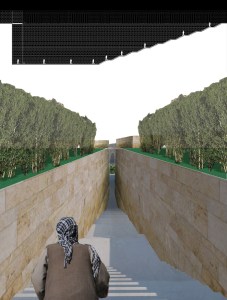
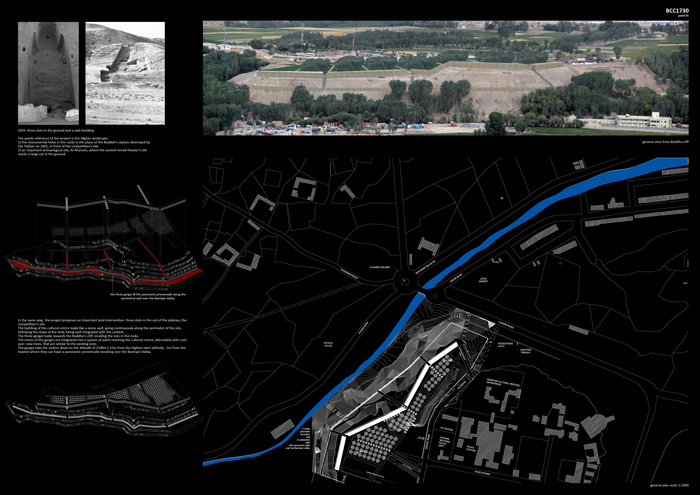
IDEA: three slots in the ground and a wall-building
The poetic reference of the project is the Afghan landscape:
the monumental holes in the rocks in the place of the Buddah’s statues destroyed by the Taliban on 2001, in front of the competition’s site.
an important archaelogical site, Ai-Khanum, where the ancient Greek theater’s site marks a large cut in the ground.
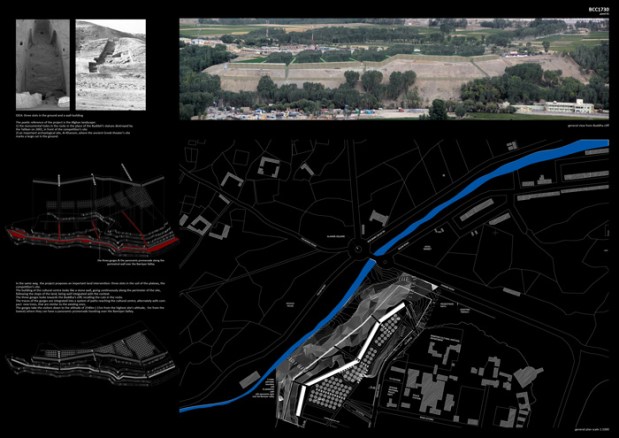
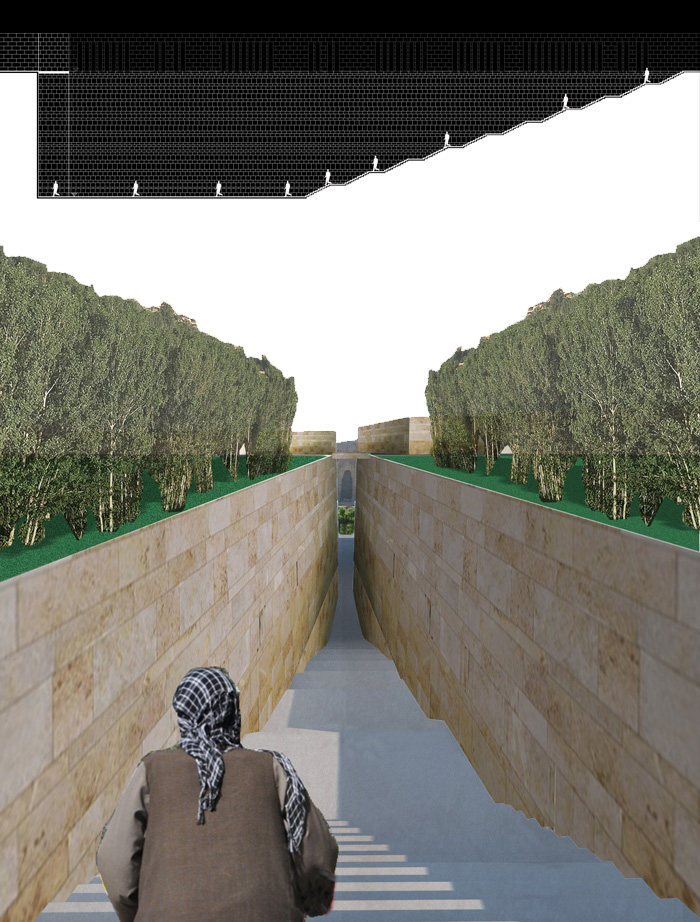
In the same way, the project proposes an important land intervention: three slots in the soil of the plateau, the competition’s site.
The building of the cultural centre looks like a stone wall, going continuously along the perimeter of the site, following the slope of the land, being well integrated with the context.
The three gorges looks towards the Buddha’s cliff, recalling the cuts in the rocks.
The traces of the gorges are integrated into a system of paths reaching the cultural centre, alternately with compact new trees, that are similar to the existing ones.
The gorges take the visitors down to the altitude of 2540m (-15m from the highest site’s altitude, -5m from the lowest) where they can have a panoramic promenade loooking over the Bamiyan Valley.
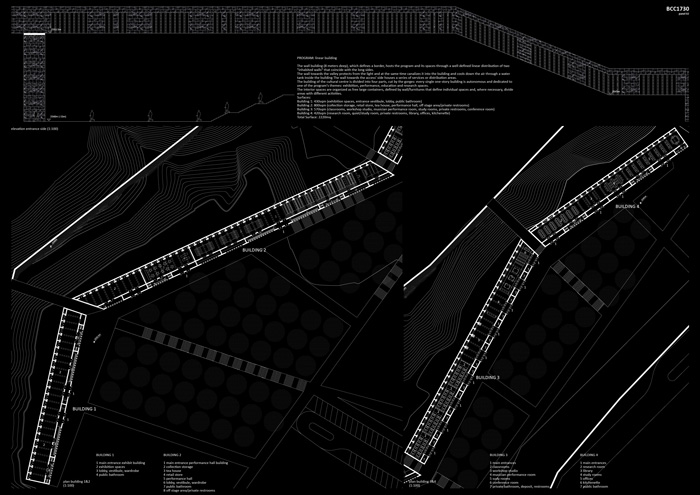
PROGRAM: linear building
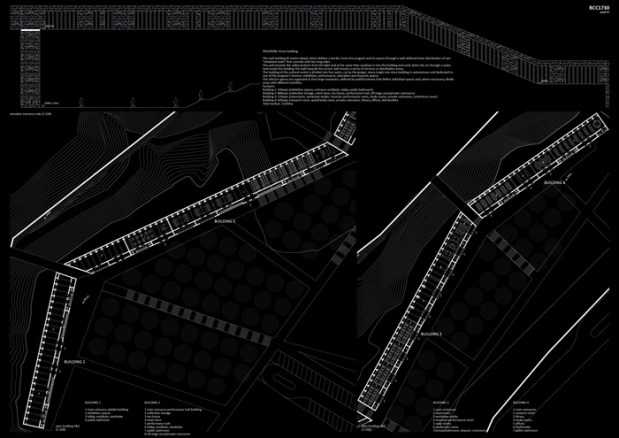
The wall building (8m deep), which defines a border, hosts the program and its spaces through a well-defined linear distribution of two “inhabited walls” that coincide with the long sides.
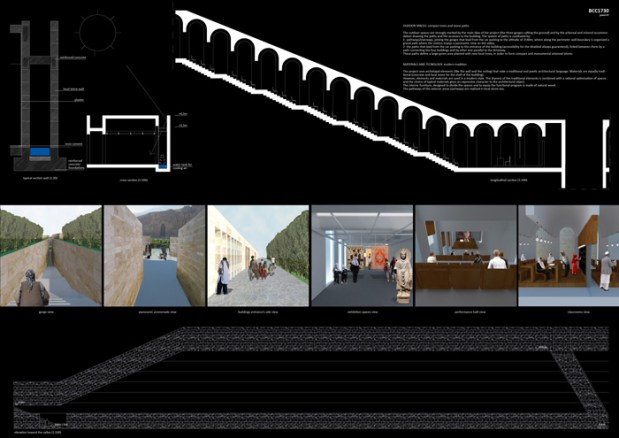
The wall towards the valley protects from the light and at the same time canalizes it into the building and cools down the air through a water tank inside the building The wall towards the access’ side houses a series of services or distribution areas.
The building of the cultural centre is divided into four parts, cut by the gorges: every single one-story building is autonomous and dedicated to one of the program’s themes: exhibition, performance, education and research spaces.
The interior spaces are organized as free large containers, defined by wall/furnitures that define individual spaces and, where necessary, divide areas with different activities.
Surfaces:
Building 1: 430sqm (exhibition spaces, entrance vestibule, lobby, public bathroom)
Building 2: 800sqm (collection storage, retail store, tea house, performance hall, off stage area/private restrooms)
Building 3: 570sqm (classrooms, workshop studio, musician performance room, study rooms, private restrooms, conference room)
Building 4: 420sqm (research room, quiet/study room, private restrooms, library, offices, kitchenette)
Total Surface: 2220mq
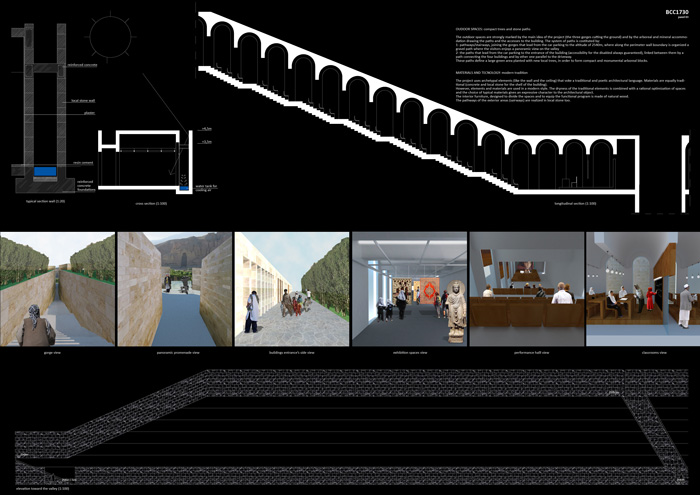
OUDOOR SPACES: compact trees and stone paths
The outdoor spaces are strongly marked by the main idea of the project (the three gorges cutting the ground) and by the arboreal and mineral accommodation drawing the paths and the accesses to the building. The system of paths is costituted by:
1- pathways/stairways, joining the gorges that lead from the car parking to the altitude of 2540m, where along the perimeter wall boundary is organized a gravel path where the visitors enjoys a panoramic view on the valley
2- the paths that lead from the car parking to the entrance of the building (accessibility for the disabled always guaranteed), linked between them by a path connecting the four buildings and by other one parallel to the driveway.
These paths define a large green area planted with new local trees, in order to form compact and monumental arboreal blocks.
MATERIALS AND TECNOLOGY: modern tradition
The project uses archetypal elements (like the wall and the ceiling) that voke a traditional and poetic architectural language. Materials are equally traditional (concrete and local stone for the shell of the building).
However, elements and materials are used in a modern style. The dryness of the traditional elements is combined with a rational optimization of spaces and the choice of typical materials gives an expressive character to the architectural object.
The interior furniture, designed to divide the spaces and to equip the functional program is made of natural wood.
The pathways of the exterior areas (sairways) are realized in local stone too.
 MD©
MD© 